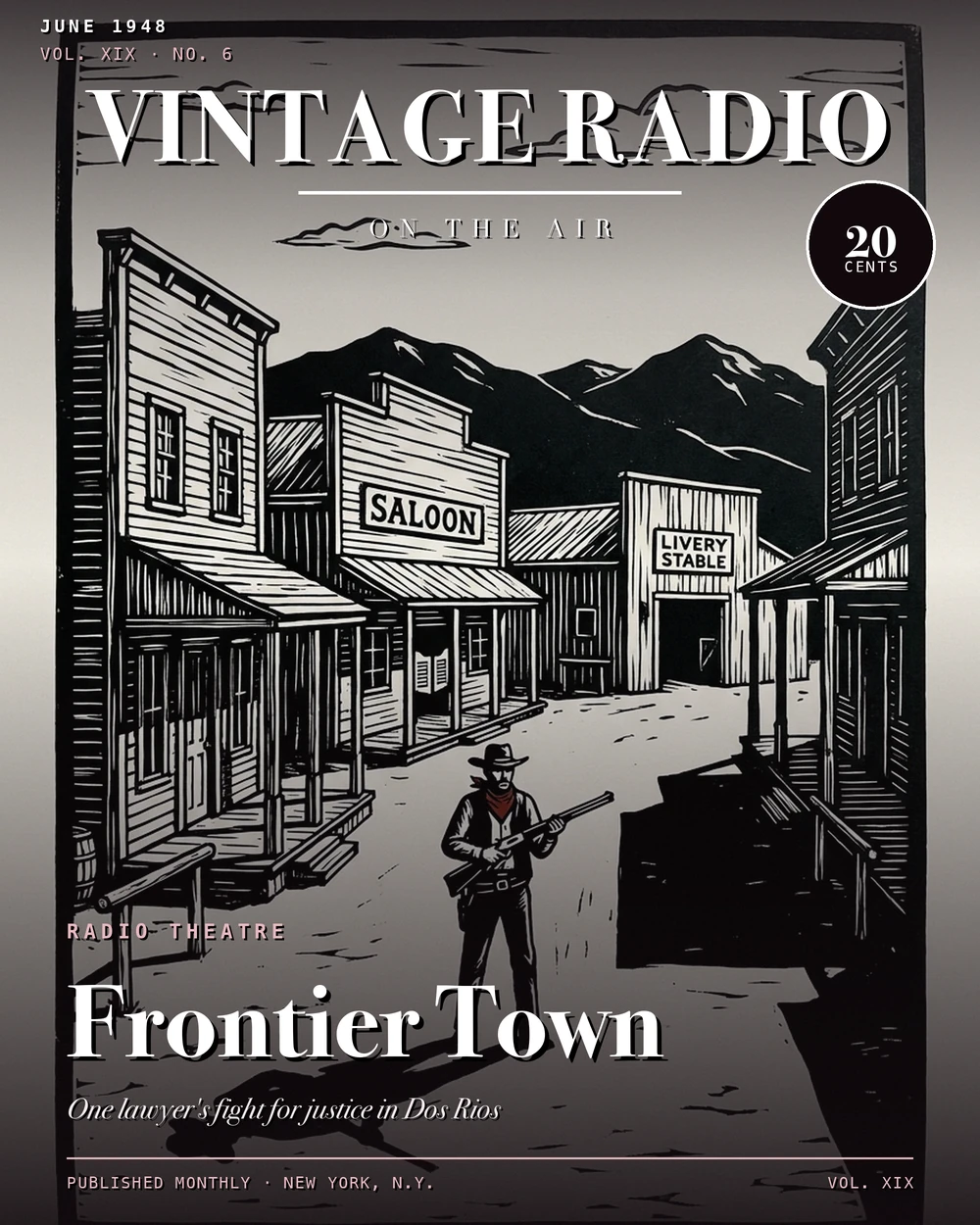
Frontier Town
A Lawyer, Not a Lawman
Most Western radio heroes carried a badge. Chad Remington carried a briefcase — or at least the frontier equivalent of one. That distinction is what set Frontier Town apart from the crowded field of Western programming that dominated radio in the late 1940s and early 1950s. When the series launched in 1949 as a syndicated production from Bruce Eells & Associates through the Broadcasters Program Syndicate, its central hook was already unusual: the hero wasn't a marshal or a hired gun but an aspiring city lawyer whose father is murdered in the small ranching town of Dos Rios. That act of violence pulls Chad Remington back to the frontier and launches his career as a crimefighting attorney working the edges of settled law in unsettled country.
The setup gave the show room to do something the standard oater rarely attempted — work through moral and legal questions rather than simply shoot its way to the end of each episode. Remington wasn't above getting his hands dirty, and the episodes take him well beyond Dos Rios into the New Mexico Territory and Colorado, where he squares off against claim jumpers, rustlers, bank robbers, and lynch mobs. But the framing of a lawyer protagonist meant the stories could turn on argument, evidence, and community judgment rather than gunfire alone.
The Making of the Show
Writer and director Paul Franklin shaped Frontier Town from episode one, with Joel Murcott co-writing at least some of the scripts. Bob Mitchell and Ivan Ditmars provided background organ music that gave the show its period texture, and Bill Forman handled announcing duties throughout the run. The first episode reached New York City audiences on WINS on March 5, 1949 — and as a syndicated release, the show aired on different stations in different markets on different days. That patchwork broadcast schedule was common for independently produced radio programming of the era, and the Broadcasters Program Syndicate was actively selling other titles at the same time, including The Adventures of Frank Race and Pat O'Brien From Hollywood.
Wild Bill Elliott was reportedly attached to star before the production settled on its eventual lead. Once the casting was finalized, the series ran for 47 episodes through 1953, covering four years and a complete fictional world built around the town of Dos Rios and its surrounding territory.
Jeff Chandler and Reed Hadley in the Lead
The role of Chad Remington had two actors over the course of the series, and both brought considerable weight to it. Jeff Chandler — born Ira Grossel on December 15, 1918 — played Remington through the first 23 episodes, billed on the show as "Tex" Chandler. By the time Frontier Town went on the air, Chandler was already known to radio audiences from Our Miss Brooks, where he played Professor Philip Boynton. His film career was accelerating at the same moment: his Oscar-nominated portrayal of Cochise in the 1950 film Broken Arrow made him a genuine movie star even as he was still recording episodes. His final episode as Remington, "Thunder over Texas," aired February 27, 1953.
Reed Hadley stepped into the part with episode 24, "Gun Trouble Valley," on March 6, 1953, and carried it to the end of the run. Hadley, born June 25, 1911, brought a deep, commanding bass voice that had served him well in radio for years — he had been the first actor to voice the cowboy hero Red Ryder on The Adventures of Red Ryder in the 1940s. His background gave him a natural authority in the Western genre, and the handoff between actors was clean enough that the series continued without a break in its storytelling rhythm.
Cherokee O'Bannon and the Rest of Dos Rios
Chad Remington's world was populated with recurring characters who gave Dos Rios a sense of being an actual place rather than a generic Western backdrop. The most distinctive was Cherokee O'Bannon, Remington's sidekick and the owner of the Dos Rios livery stable — a hard-drinking gentleman of mixed blood played by character actor Wade Crosby across all 47 episodes. Crosby, born August 22, 1905, built the character on the speech patterns of W.C. Fields, which gave O'Bannon a comic eccentricity that balanced the more serious material in the scripts. He stayed with the series until it ended in 1953 and lived another two decades, dying in October 1975.
Judge Fillmore, played by Earle Ross, filled out the institutional side of Dos Rios — a recurring presence that reinforced the show's legal and civic framework. The combination of a lawyer protagonist, an eccentric sidekick, and a judge as supporting character gave Frontier Town a more courtroom-adjacent feel than most Westerns of its time, even when the action was taking place far from any courthouse.
What the Episodes Were Like
The 47 surviving episodes span a wide range of frontier situations. Titles like "Bullets for Boot Hill," "Branding the Badlands," "Six Gun Lawyer," and "Trouble Rides the Rails" suggest the standard adventure territory, while others — "The Poisoned Waterhole," "The Chavez Family," "Emily Bracket," and "Marie" — point toward the character-driven and community-focused stories the show apparently favored. "The Coach That Arrived Missing" and "The Seminole Strip" suggest the kind of puzzle-centered plotting that gave Remington's legal instincts something to work with.
Each episode is self-contained, which made the syndicated format workable — stations could air episodes in whatever order fit their schedules without leaving audiences lost. But the recurring cast and the consistent setting of Dos Rios gave listeners who followed the show from week to week a sense of continuity. The stories turn on justice, bravery, and the tensions of frontier community life: who has a right to the land, who gets to define the law when formal institutions are thin on the ground, and what it costs a person to do the right thing in a place where the rules are still being worked out.
Where It Stood in Western Radio
Frontier Town ran during the same years that Gunsmoke was defining the adult Western for radio audiences, and it shares the broad category of Westerns that took their genre seriously rather than treating it as pure formula. The lawyer-hero concept was genuinely unusual — closer in spirit to a frontier procedural than to the standard shoot-em-up — and the consistent presence of Wade Crosby as Cherokee O'Bannon across all 47 episodes gave the show a personality that distinguished it from the competition. It wasn't the biggest Western on the air during its four-year run, but it carved out a dedicated audience with a storytelling approach that trusted listeners to care about motivation and consequence, not just action.